Top 10 Historic Facts About the Indian Flag
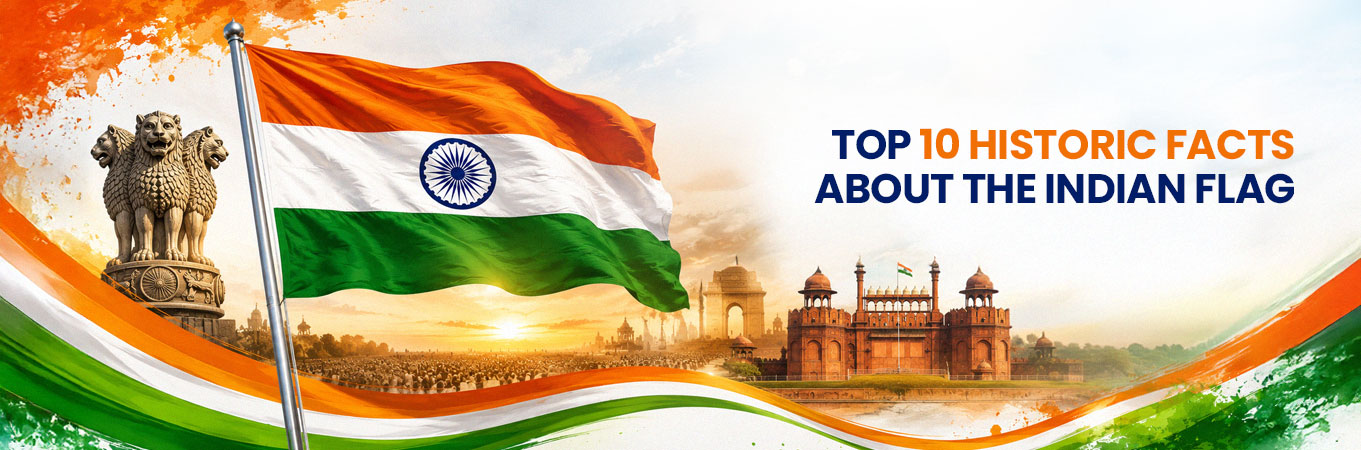
Long before it became common on buildings and houses, the Indian national flag was an idea in the making. It underwent several changes during the time India was struggling for freedom. Our Tiranga represents years of thoughtful reflection and heartfelt conversations, all driven by a meaningful purpose.
The Indian flag is not just about design, but it also weaves a story of its own. This refers to how a nation decided to mark its turning point. Here are ten less-discussed and lesser-known facts that bring that journey into focus.
1. The Indian Flag Was Adopted With Historic Precision
India did not have years to arrive at a flag. The Indian national flag was officially adopted on 22nd July 1947, just a few days before Independence Day. The timing itself adds weight to the fact that the country stepped into freedom with a symbol that had recently been finalised but was widely accepted and loved. Click here for related blog
2. Pingali Venkayya: The Visionary Behind the Indian National Flag
The Indian tricolour flag was not designed with a hasty sketch. It took several failed designs, a number of years, and countless iterations. Pingali Venkayya studied flags of several nations for many years before arriving at this. He was methodical in his approach, not casual, and therefore designed the pride of the Nation with his visionary excellence!
3. The First Historic Hoisting: 15th August 1947
On 15th August 1947, the Indian national flag was hoisted for the first time, a moment generations had waited for. Just a few hours back, at midnight, Prime Minister Jawaharlal Nehru had delivered his iconic "Tryst with Destiny" speech in the Central Hall of Parliament, declaring India's arrival as a free nation. That afternoon, the first public flag hoisting took place at Princess Park, near India Gate in New Delhi, where Nehru himself unfurled the Tiranga before thousands of high-spirited, joyous citizens who had lived through decades of colonial rule. The flag rising into the sky that day gave the speech its most powerful, visible and physical form, a nation finally free, with its own colours flying high in the sky.
4. The Flag remains Perfectly Proportioned, Always
The Indian national flag maintains a constant 2:3 ratio no matter where it is flown (on a large flagpole or a small one). The 2:3 ratio gives the national flag a consistent appearance regardless of the method used to create or display it.
5. Khadi: The Fabric of Self-Reliance and National Pride
Originally, the Indian national flag was made only from khadi, which signified self-reliance and National Pride. The flag’s restrictions were not just limited to fabrics but were also representative of self-sufficiency during India’s struggle for independence.
6. The Flag Was Not Always Accessible to Citizens
For many years after Independence, ordinary citizens in India could only fly the national flag during official events. This changed in 2002, when the Flag Code of India came into effect on 26 January. A very significant role in this shift was played by Naveen Jindal, who fought a long drawn case in the Supreme Court. His victory gave every Indian the right to fly the Tiranga with dignity on any day. What was once limited to formal occasions, now became a symbol of everyday pride, seen across homes, institutions, and public spaces.
7. Every Colour holds a significant meaning
The colour scheme of the Indian national flag was designed after lengthy consideration of each colour and what it represented. The manner in which these three colours were balanced against one another was done thoughtfully as well.
Saffron represents courage and sacrifice.
White stands for truth, peace, and purity.
Green symbolises prosperity and the land's fertility.
And at the centre, the navy-blue Ashoka Chakra represents the Laws of Dharma, the force that keeps everything in motion and in balance, that we see today in the centre of India’s national flag was not always there. Previous iterations of the flag had charkha and other design elements.
8. The Tiranga Stood on Top of the World
On 29th May 1953, Edmund Hillary and Tenzing Norgay became the first people to summit Mount Everest, the highest point on Earth. Among the flags they carried to that frozen peak was the Indian national flag. At 8,849 metres above sea level, the Tiranga flew where no human had ever stood before. This mountaineering milestone was a bold declaration that free India had visibly arrived on the world stage.
9. The Tiranga Travelled to Outer Space
On 2nd April 1984, Wing Commander Rakesh Sharma became the first Indian to travel to space, as part of the Indo-Soviet joint space mission. He carried the Indian national flag as an emblem on his spacesuit. When asked how India looked from space, his answer, 'Saare jahan se accha', became legendary. The Tiranga on his chest proudly made the journey with him, becoming the first Indian flag to leave the Earth's atmosphere and land in space!
10. The Largest Indian Flag in the World
India's pride in its flag was expressed in the most monumental way possible at the Indo-Pak Attari Border, where the nation's largest flag stands tall. Measuring 110 metres in length, 24 metres in width, and weighing an extraordinary 55 tonnes. Visible from miles away, it is a symbol of unwavering identity and dignity.
Looking at the Indian National Flag Differently
Most people identify the Tiranga as the national flag, a symbol of pride, but many fail to address how it was developed. Understanding the history or development of the Indian national flag allows for greater appreciation of its intended purpose.
Once people understand its historical significance, the Tiranga will be seen as more than just a symbol of national pride. It is a treasured part of our shared history and identity and has a much greater significance.
The spirit of keeping the Tiranga alive and visible has found a powerful champion in Naveen Jindal, the man who fought a decade-long legal battle all the way to the Supreme Court, winning in 2004, securing the right for every Indian citizen to fly the national flag with pride, every single day. What began as one man being told he couldn't fly the flag at his own factory became a fundamental right for over a billion people. Through the Flag Foundation of India, which he founded in line with the same spirit, Jindal has since installed over 200 monumental flags across the country and is now heading towards an initiative where Indians, primarily the youth, is registering to build the world's largest digital Tiranga, a flag that belongs not just to a border or a building, but to every Indian with a screen and a sense of pride.
As one learns more about the Indian National Flag, it becomes clear that its creation was a deliberate and diligent process and not simply a product of artistic expression. If you wish to be a part of the next big fact about our National flag, register yourself at FFOI today! Building pride in pixels!
Comments
0 CommentsNo comments yet. Be the first to share your thoughts.
Leave a comment